Introduction
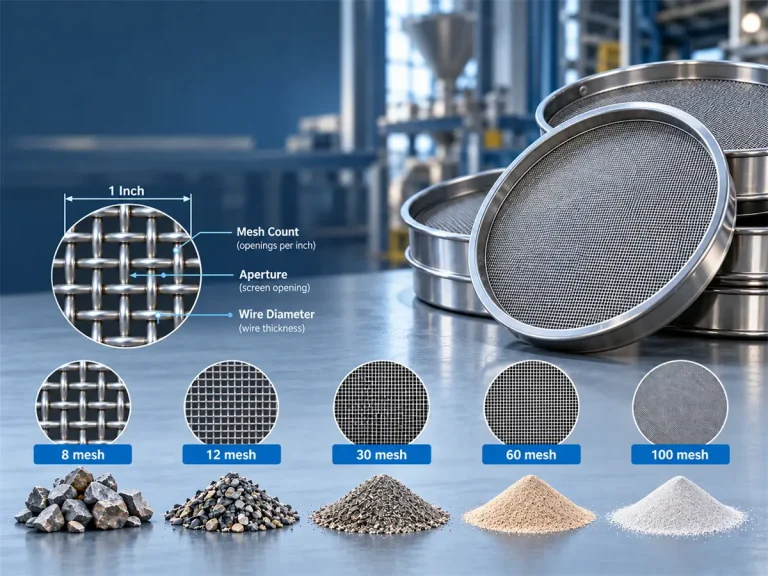
Different materials require different screening motion, screen area and mesh configurations. Fine powders generally need more controlled material movement and anti-blinding capability, while sand, minerals and granules often require larger screening area and continuous throughput.
This guide compares linear and rotary vibrating screens by material type, particle size, capacity and screening duty.
Linear vs Rotary Vibrating Screens by Material Type
Material type provides a useful starting point for vibrating screen selection, but it should not be used as the only criterion. The same material may require a different screen when the particle size, moisture, flowability, capacity or required separation accuracy changes.
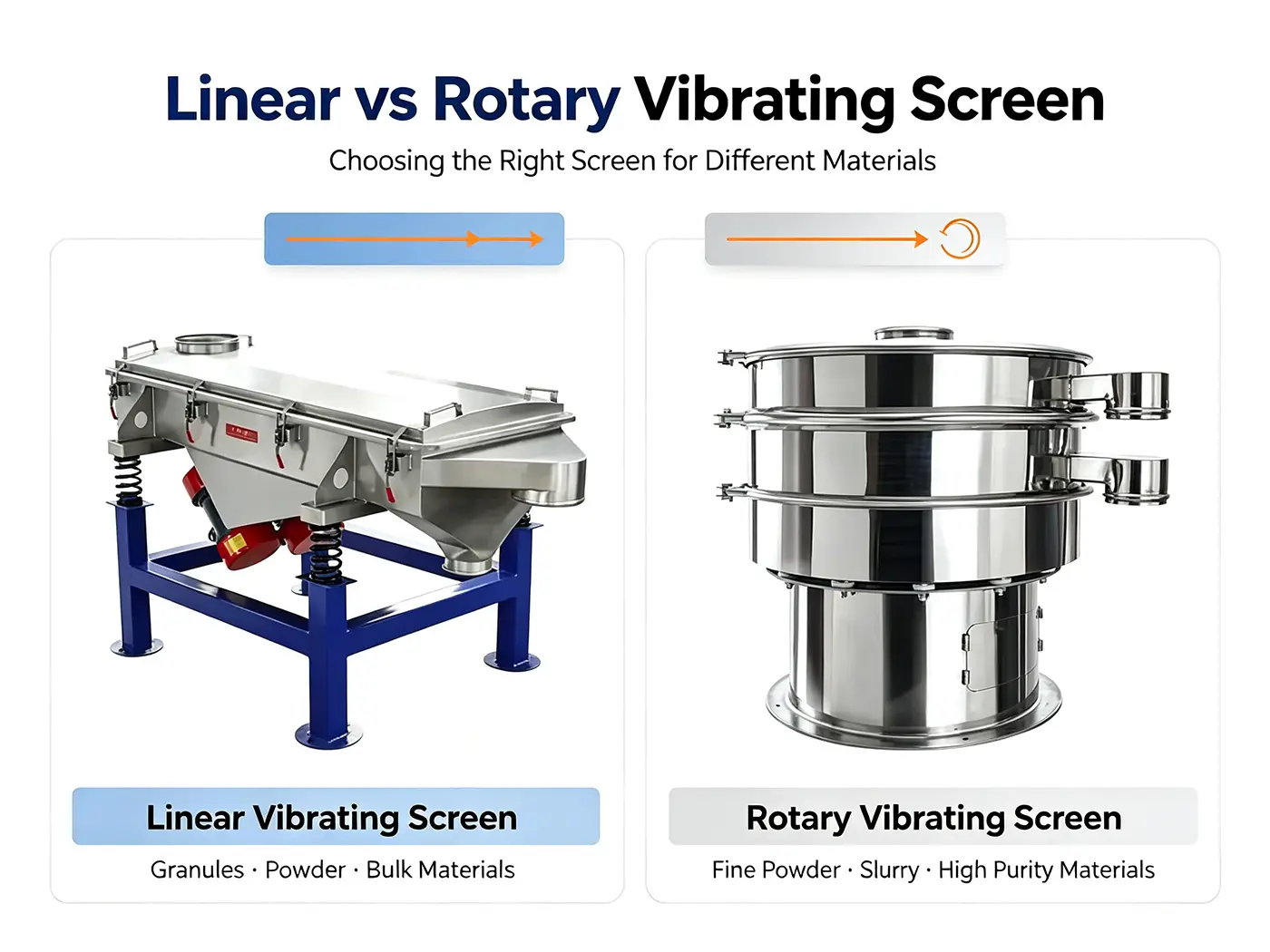
As a general rule, linear vibrating screens are more commonly evaluated for continuous, higher-capacity classification of free-flowing granules and bulk solids. Rotary vibrating screens are often preferred for fine powders, safety screening and applications requiring controlled material movement. Difficult fine powders may require ultrasonic assistance, while high-capacity precision grading may call for a gyratory screen.
The table below provides a preliminary selection reference.
| Material / Application | Screening Range (Mesh / mm) | Screening Duty | First Option to Evaluate | Engineering Selection Notes |
| Fine Powders | 35–325 mesh / 0.50–0.045 mm | Fine classification / scalping | Rotary Vibrating Screen | Suitable for controlled fine screening. Below about 100 mesh (0.15 mm), flowability, near-size particles and mesh blinding become increasingly important. |
| Food Powders | 20–200 mesh / 0.85–0.075 mm | Safety screening / grading | Rotary Vibrating Screen | Common for flour, starch, sugar and similar powders. Confirm product specification, hygiene requirements, screen material and cleaning method. |
| Chemical Powders | 40–325 mesh / 0.425–0.045 mm | Fine classification / impurity removal | Rotary / Ultrasonic Screen | For fine or cohesive powders, check static buildup, agglomeration and mesh blinding before deciding whether ultrasonic assistance is required. |
| Quartz / Silica Sand | 4–140 mesh / 4.75–0.106 mm | Classification / multi-size grading | Linear Vibrating Screen | Suitable for continuous classification. For abrasive sand, screen wire diameter, open area, wear life and required capacity should be evaluated together. |
| Frac Sand / Proppant | 20–140 mesh / 0.85–0.106 mm | Precision multi-fraction grading | Gyratory / Linear Screen | Typical product grades include 20/40, 30/50, 40/70 and 70/140 mesh. Each grade requires multiple separation points rather than one screen aperture. |
| Garnet / Abrasive Minerals | 6–140 mesh / 3.35–0.106 mm | Product sizing / classification | Linear / Gyratory Screen | Abrasive wear can change effective aperture over time. Balance wire diameter, open area, screening capacity and replacement interval. |
| Mineral Powders | 20–200 mesh / 0.85–0.075 mm | Classification / fines removal | Linear or Rotary Screen | Linear screening suits higher-throughput, free-flowing material; rotary screening can be evaluated for finer classification and lower-capacity precision duties. |
| Plastic / Resin Granules | Approx. 2–18 mesh / 10–1.0 mm | Oversize / fines removal | Linear Vibrating Screen | Free-flowing pellets are generally suitable for continuous linear screening. Specify actual aperture in mm for coarse granules rather than relying on mesh count alone. |
| Fertilizer Granules | Approx. 3–18 mesh / 6–1.0 mm | Product sizing / oversize removal | Linear Vibrating Screen | Larger rectangular screening areas suit continuous production. Moisture and surface coating should be checked because they can increase adhesion and reduce capacity. |
| Lightweight Powders | 35–200 mesh / 0.50–0.075 mm | Fine classification | Rotary Vibrating Screen | Low bulk density can reduce effective contact with the screen. Feed rate, material distribution and vibration parameters require closer control. |
| Electrostatic / Cohesive Powders | 60–400 mesh / 0.25–0.038 mm | Fine / ultra-fine screening | Rotary + Ultrasonic | Ultrasonic assistance can be evaluated when static, agglomeration or persistent blinding limits conventional screening. Fine mesh alone does not automatically require ultrasonic. |
| Coarse Granules / Bulk Solids | Approx. 2–10 mesh / 10–2.0 mm | Scalping / classification | Linear Vibrating Screen | Directional material transport and larger screen decks suit continuous processing. For coarse products, specifying the aperture directly in mm is preferred. |
Mesh conversion reference: 20 mesh ≈ 0.85 mm, 40 mesh ≈ 0.425 mm, 60 mesh ≈ 0.25 mm, 100 mesh ≈ 0.15 mm, 140 mesh ≈ 0.106 mm, 200 mesh ≈ 0.075 mm, and 325 mesh ≈ 0.045 mm.
Mesh-to-mm values are nominal references. Actual screen opening can vary with wire diameter, weave and screen standard. For equipment orders, Sanyuantang recommends confirming the required aperture in mm or μm, especially for precision classification.
Selection Guide
For coarse particles and granules above approximately 2 mm, aperture in mm is generally more useful than mesh count. For fine powders below approximately 0.5 mm, buyers commonly use both mesh and micron/mm specifications.
Sanyuantang therefore recommends providing the target particle size or product grading specification first. We then check the required aperture against feed particle-size distribution, capacity, moisture, bulk density and material behavior before selecting a linear, rotary, ultrasonic or gyratory screening configuration.
Vibrating Screen Selection
Get a Screen Recommendation
Share your material, feed size, required product sizes, capacity and operating conditions. We will help evaluate the right screen for your project.
Response within one business day
Which Is Better for Fine Powder: Linear or Rotary Vibrating Screen?
For fine powder screening, a rotary vibrating screen is generally the first option for fine classification, safety screening and oversize removal. Its three-dimensional motion provides longer material contact with the screen surface, which is useful when working with smaller apertures and controlled product specifications.
A linear vibrating screen can still be considered for dry, free-flowing powders where higher throughput and a larger effective screening area are required. The choice should therefore be based on particle-size distribution, target aperture, capacity, bulk density, moisture and flowability, rather than particle size alone.
For powders prone to agglomeration, static buildup or mesh blinding, Sanyuantang recommends evaluating an ultrasonic screening system or carrying out a material test before the final screen configuration is confirmed.
The screen aperture should always follow the required cut size. For reference, 100 mesh is approximately 0.15 mm (150 μm), 200 mesh about 0.075 mm (75 μm), and 325 mesh about 0.045 mm (45 μm). Actual aperture should be confirmed according to the screen specification.
For aperture selection and mesh conversions, see How to Select Vibrating Screen Mesh Size?
Which Vibrating Screen Has Higher Capacity?
Linear vibrating screens generally provide higher capacity for continuous screening, while rotary vibrating screens are more focused on fine classification and controlled screening. The table below compares the main factors that affect their throughput and application range.
| Capacity Factor | Linear Vibrating Screen | Rotary Vibrating Screen |
| Capacity Potential | Higher for continuous screening | Moderate, mainly for fine/precision screening |
| Duty | Continuous classification and grading | Fine screening, scalping and impurity removal |
| Suitable Feed | Powders, granules, sand and bulk materials | Fine powders and small granules |
| Screening Area | Larger rectangular deck | Compact circular deck |
| Material Flow | Continuous directional movement | Three-dimensional circular movement |
| Particle Range | Approx. 2–325 mesh / 10–0.045 mm* | Approx. 20–400 mesh / 0.85–0.038 mm* |
| Best Capacity Condition | Dry, free-flowing material with limited near-size particles | Free-flowing powder with moderate feed rate |
| Fine Mesh Capacity | Decreases as aperture becomes finer | Also decreases; anti-blinding may be required |
| Multi-Deck Screening | Available | Available |
| Best Choice When | Throughput and continuous operation are priorities | Fine screening and compact installation are priorities |
*Particle ranges are application references, not equipment limits. Actual capability depends on the machine model, screen aperture, material properties and required separation efficiency.
Selection Guide: For the same machine size, throughput can change significantly when the aperture changes from a coarse opening to 100 mesh (0.15 mm), 200 mesh (0.075 mm) or finer. Capacity should therefore be specified together with the material, target cut size and particle-size distribution, rather than compared by screen type alone.
How to Choose Between a Linear and Rotary Vibrating Screen?
Choosing between a linear and rotary vibrating screen starts with the screening duty, not the machine type. Evaluate the material, particle size, required capacity, screening accuracy and operating conditions first, then match these requirements to the appropriate screen configuration.
Check the Material
Define powder, granule, bulk solid or slurry. Confirm bulk density, moisture, flowability, abrasion and agglomeration.
Define Particle Size
Provide feed range and required cut sizes in mm or μm. These points determine aperture and deck count.
Confirm Required Capacity
State the target in kg/h or t/h. Throughput affects screen area, loading, bed depth and machine size.
Set Accuracy and Fractions
Confirm scalping, classification, dedusting or multi-fraction screening. The duty is more useful than material name alone.
Check Material Behavior
Review moisture, stickiness, agglomeration, static, abrasion and near-size particles. Difficult feeds may need cleaning or ultrasonic assistance.
Review Plant Layout
Confirm floor space, inlet height, discharge direction, conveyor links, dust collection and maintenance access.
Linear or Rotary Vibrating Screen: Quick Selection Guide
The table below provides a quick reference for selecting between linear and rotary vibrating screens based on material, particle size and screening duty. Final configuration should be confirmed against the required capacity and actual operating conditions.
| Screening Requirement | First Option | Main Reason |
|---|---|---|
| Fine powder classification | Rotary Vibrating Screen | Controlled fine screening |
| Safety screening | Rotary Vibrating Screen | Compact enclosed design |
| Difficult fine powder | Rotary + Ultrasonic | Controls mesh blinding |
| High-capacity screening | Linear Vibrating Screen | Large effective screen area |
| Granules and bulk solids | Linear Vibrating Screen | Continuous directional flow |
| Sand and minerals | Linear Vibrating Screen | Bulk classification duty |
| Several finished fractions | Evaluate Both | Depends on cuts and capacity |
| High-accuracy separation | Test Material First | Behavior determines performance |
What Information Do We Need to Recommend a Vibrating Screen?
To recommend a suitable vibrating screen and configuration, please provide the following basic process information. This helps us match the screen size, mesh and capacity to your actual screening requirements.
Project Data
Information Required for Screen Selection
Provide the actual operating data for reliable equipment sizing.
| Project Data | Example | Why It Matters |
|---|---|---|
| Material | Quartz sand | Defines screening and wear behavior |
| Feed Size | 0–5 mm | Establishes incoming particle range |
| Required Product Size | 40/70 mesh | Defines separation requirements |
| Capacity | 10 t/h | Determines required screen area |
| Moisture | Less than 1% | Indicates blinding risk |
| Bulk Density | 1.5 t/m³ | Supports capacity calculation |
| Number of Fractions | 3 | Determines deck configuration |
| Operating Hours | 16 h/day | Helps evaluate duty and wear |
| Special Requirements | Dust-tight / SS304 | Defines equipment construction |
FAQs
What is the difference between a linear and rotary vibrating screen?
A linear screen uses directional vibration on a rectangular deck. A rotary screen uses three-dimensional vibration on a circular deck. Linear screens suit continuous high-capacity classification; rotary screens suit fine powder screening and impurity removal.
Which is better, a linear or rotary vibrating screen?
Neither is universally better. Compare feed size, cut size, capacity, moisture, flowability and required fractions before selection.
Which vibrating screen is best for fine powder?
A rotary vibrating screen is usually the first option. Moisture, agglomeration, static and throughput still affect performance; ultrasonic assistance may be needed for persistent blinding.
Which vibrating screen has higher capacity?
Linear screens generally offer higher capacity potential, but aperture, screen area, bulk density, moisture and particle-size distribution determine actual throughput.
Can a linear vibrating screen screen fine powder?
Yes. Linear screens can handle many dry, free-flowing fine powders, especially where relatively high throughput is required. Cohesive or electrostatic powders may need anti-blinding measures.
Can a rotary vibrating screen handle multiple particle sizes?
Yes. A multi-deck rotary screen can separate one feed into several fractions. The practical number depends on feed distribution, deck loading and capacity.
Which vibrating screen is better for sand?
Linear vibrating screens are often the first option for quartz sand, silica sand and other granular minerals requiring continuous throughput and several size fractions.
How do I choose the right vibrating screen?
Start with material, feed size, required cut size, capacity and product fractions. Then check moisture, bulk density, flowability, abrasion and installation conditions.
For materials with difficult flow, fine particle sizes or uncertain behavior, complete a material screening test before the final equipment specification is confirmed.
Choose the Right Vibrating Screen for Your Process
The right screen depends on the material, target particle size, required capacity and screening duty. Linear vibrating screens are generally suited to continuous, higher-throughput classification, while rotary vibrating screens are more commonly used for fine screening and impurity removal.
For final selection, Sanyuantang recommends confirming the feed size, required cut size, capacity and material characteristics together. This provides a more reliable basis for selecting the screen type, mesh and equipment configuration.
Need a Screening or Material Handling Solution?
Tell us your material, particle size, required capacity and process requirements. Sanyuantang can recommend suitable screening, conveying and feeding equipment, or configure a complete material handling line for your project.